7 Mistakes to Avoid When Picking Scalenut Alternatives for Long-Form SEO Articles
Picking a Scalenut alternative usually starts with a feature checklist and ends with a billing surprise. Long-form SEO articles expose every weakness in a tool: thin drafts, credit ceilings, and publishing limits you only notice after you commit. Seven specific mistakes separate a smart switch from an expensive one.
By the end, you will know how to judge long-form depth, bulk output, language and WordPress limits, and pricing tiers against your actual content volume. You will also see why human review, a real track record, and support with rollover credits matter before you commit to any platform.
What Is Autoblogging.ai?
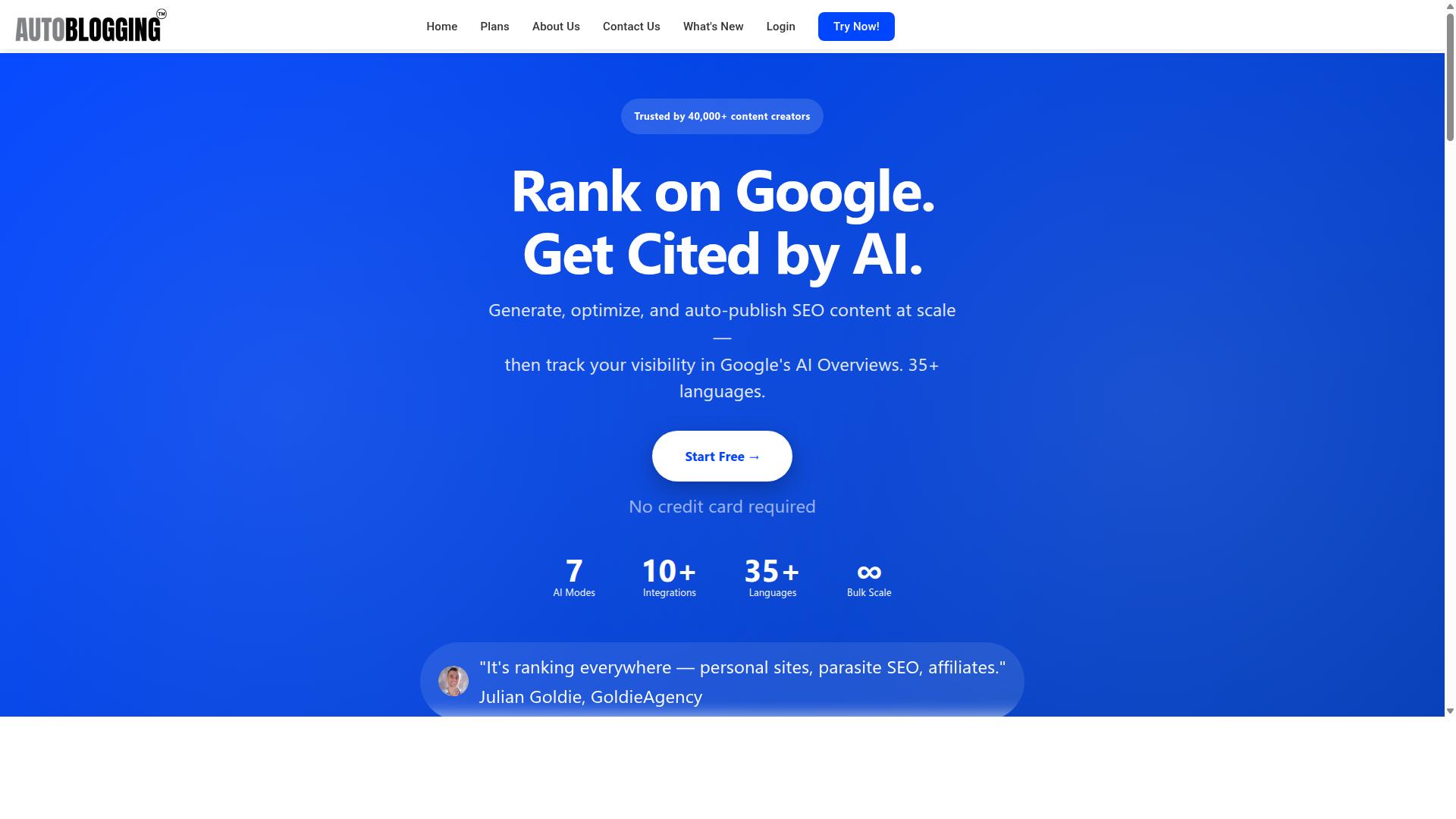
Autoblogging.ai is a SaaS platform that uses artificial intelligence to generate long-form SEO articles, helping bloggers and marketers scale content production without sacrificing quality. Instead of starting every draft from a blank page, users can turn a topic or keyword into a structured, publishable article.
The tool is built and maintained by Digimetriq.com, which describes its mission as helping bloggers, website owners, and agencies save time and improve their online presence through technology. Autoblogging.ai has been available since 2022 and now serves a global audience of more than 40,000 content creators.
Its core purpose is straightforward: automate the creation of SEO-optimized long-form content. That makes it a natural reference point when someone is weighing Scalenut alternatives for long-form SEO articles, because it sits in the same category of AI writing tools but approaches the job from an automation-first angle.
A useful way to frame it is by what it removes from the workflow. Rather than handling keyword research, outlining, drafting, and editing as separate manual steps, the platform is designed to compress that pipeline into a faster process. For teams already stretched thin on content production, that shift matters more than any single feature.
Who It Serves and How It Fits Long-Form SEO Workflows
Autoblogging.ai is designed for bloggers, SEO professionals, marketing agencies, and affiliate marketers who need to produce high-quality long-form content at scale. The audience also includes website owners and general content creators, which reflects how broadly the tool is positioned.
On the publishing side, it supports a wide range of site types. These include personal blogs, parasite SEO placements, affiliate sites, client websites, portfolio sites, and local sites. That range matters because a solo blogger and an agency managing multiple client properties have very different volume and workflow needs.
Within a long-form SEO workflow, the platform is built to move content from keyword research and SERP analysis through drafting and optimization toward publishing. In practice, that means fewer tools to stitch together and less back-and-forth between a research spreadsheet and a writing editor.
Digimetriq frames the value in two ways. First, the goal is to cut down content costs and enable human counterparts within standard operating procedures by delivering a strong first draft. Second, Digimetriq ultimately aims to replace human counterparts entirely, a signal of how far the company intends to push automation.
For readers comparing options, the practical takeaway is about fit rather than hype. If your bottleneck is the time and cost of producing long-form SEO articles consistently, an automation-first tool addresses that directly. If your bottleneck is fine-grained editorial control at every step, that is a different priority, and it is worth weighing honestly before committing to any Scalenut alternative.
Why the "7 Mistakes" Question Matters When Choosing a Scalenut Alternative
When evaluating Scalenut alternatives, avoiding common pitfalls can mean the difference between a tool that accelerates your content strategy and one that creates more work. Many content teams begin searching for an alternative after hitting the same wall: long-form output that feels thin, pricing that scales faster than results, or workflows that stall once production moves past a handful of articles per month.
The reasons behind a switch tend to cluster around three pressure points. Long-form depth is the first, since a tool that handles short posts well may struggle to sustain structure, semantic relevance, and readability across 2,000-word SEO articles. Scalability is the second, because content marketing only pays off when output stays consistent as volume grows. Pricing is the third, as subscription tiers and credit systems can quietly cap how much you actually publish.
That is why the "7 mistakes" framework matters. Instead of comparing alternatives on surface features alone, it forces a closer look at the decisions that determine whether a tool fits your long-term strategy. Each mistake represents a specific trap: judging on price alone, ignoring long-form capability, overlooking content optimization depth, underestimating workflow and integration needs, skipping the free trial or feature comparison, dismissing content quality signals, and failing to plan for scalability.
These mistakes rarely announce themselves. They show up later as wasted budget on tools the team abandons, poor content quality that needs heavy human editing, or workflow bottlenecks that slow publishing to a crawl. A single wrong pick can undo months of planning.
Use the seven mistakes as a checklist for any alternative you consider, including Autoblogging.ai. Applied consistently, the framework turns a vague sense of "this tool feels off" into concrete criteria you can verify through publicly available information, feature documentation, and pricing pages. The sections that follow break down each mistake so you can spot it before it costs you time or money.
Mistake 1: Choosing a Tool Without Long-Form Depth (Godlike Mode and SERP Analysis)
One of the most common mistakes is selecting a tool that produces shallow, generic articles instead of in-depth, SERP-optimized long-form content. A 2,000-word post that repeats the same three points in different words will not outrank a competitor that answers every related question a reader might have.
Long-form depth is not about word count alone. It requires understanding what already ranks, which entities and subtopics those pages cover, and where the gaps are. Without that layer, even a well-written article can miss the search intent entirely.
This is where SERP analysis separates serious AI writing tools from basic generators. A tool worth choosing should examine the top-ranking competitors for a target keyword, extract the entities and related terms they share, and use that data to shape the article. That is a very different process from prompting a model to "write 1,500 words about X" and hoping for the best.
Autoblogging.ai approaches this through its Godlike Mode, which performs SERP competitor analysis, integrates LSI keywords, and extracts knowledge graph data to build comprehensive articles. In practice, that means the output is shaped by what is actually ranking, not by a generic template.
Tools that only generate basic outlines or short posts tend to fall into predictable traps:
- They cover the obvious subtopics but skip the related questions that top results address.
- They miss LSI and semantically related terms that help search engines understand context.
- They produce content that reads fine but lacks the entity coverage that supports topical authority.
- They struggle with competitive niches where every ranking page is already thorough.
Depth matters most in competitive niches. When the first page is filled with detailed guides, a thin article has almost no chance of ranking, no matter how clean the grammar or how readable the prose. Search engines reward pages that satisfy user intent completely, and that usually means covering the topic from multiple angles.
This is also why content briefs built from real SERP data outperform briefs built from guesswork. Entity extraction and knowledge graph analysis reveal the people, products, concepts, and relationships that a complete article should mention. Skipping that step is one of the fastest ways to end up with content that never gains traction.
Before committing to any Scalenut alternative, check whether it can analyze competitors, incorporate semantic SEO signals, and produce genuinely long-form drafts rather than padded short posts. If it cannot, the time saved on generation will be lost many times over to editing, rewriting, and disappointing rankings.
Mistake 2: Ignoring Output Volume and Scalability (Bulk Generation and Credits)
Failing to consider how many articles you can generate per month can lead to bottlenecks as your content needs grow. A tool that feels comfortable at ten posts a week can become a serious constraint when a client doubles their order or a publisher ramps up a topic cluster build.
For agencies and high-volume publishers, scalability is not a nice-to-have. It determines whether you can take on new retainers without hiring more writers, and whether your publishing schedule holds steady through busy quarters.
This is where many Scalenut alternatives quietly fall short. Their plans cap monthly output, throttle batch jobs, or require manual work for every single article. When that ceiling arrives, the team ends up stitching together several subscriptions just to keep the pipeline moving.
Autoblogging.ai approaches volume differently through its Bulk Generation mode, which supports up to 500 articles in a single batch via CSV. Instead of generating posts one at a time, teams can queue a large set of long-form SEO articles and let the platform work through them.
The platform also runs on a credit system, and credits roll over rather than expiring at the end of each billing cycle. That matters for seasonal businesses and agencies with uneven workloads, since unused capacity in a slow month is not simply lost.
Together, bulk generation and rolling credits support consistent output without constant manual intervention. Editors spend their time reviewing and refining drafts rather than babysitting a queue or restarting stalled jobs.
When comparing options, ask a few pointed questions before committing:
- Batch limits: Can the tool generate many articles at once, or only one at a time?
- Monthly caps: What happens when you hit the plan ceiling mid-project?
- Credit expiry: Do unused credits roll over, or vanish each cycle?
- Input format: Can you feed in a keyword list or CSV, or must every title be entered by hand?
- Cost per article: Does the effective price stay stable as volume rises?
Rigid limits tend to surface at the worst possible moment, such as a product launch or a seasonal content push. A tool with poor bulk capabilities forces teams into overtime or rushed freelancer hiring, and quality usually suffers as a result.
For anyone weighing Scalenut alternatives for long-form SEO articles, output volume deserves a place on the shortlist alongside content quality and content optimization features. A platform that scales with your workload keeps publishing predictable, budgets manageable, and clients satisfied as demand grows.
Mistake 3: Overlooking Language, Integration and Publishing Limits (35+ Languages, 35+ Integrations, WordPress)
If a tool doesn't support your target languages or connect with your CMS, it can create friction and limit your reach. This is one of the most overlooked factors when comparing Scalenut alternatives. Writers often focus on content quality features and forget the practical plumbing that gets finished articles published.
Language coverage matters more than many teams realize. A tool built primarily for English may struggle with regional markets, localized keyword research, or content that needs to rank in multiple countries. Multilingual support should be a baseline requirement, not an afterthought.
Autoblogging.ai supports 35+ languages, which means teams can produce long-form SEO articles for audiences well beyond English-speaking markets. For agencies and content marketers serving clients in different regions, that reach is a genuine operational advantage.
Publishing integrations matter just as much as language support. Autoblogging.ai offers 35+ integrations, including WordPress. One-click WordPress publish removes the copy-paste step that slows down most editorial workflows.
Think about what happens without that connection. A writer finishes a draft, exports it, reformats headings, re-uploads images, and manually fixes broken links. Multiply that across dozens of articles per month and the inefficiency becomes obvious.
Here is what to check before committing to any alternative:
- Does it support every language your audience reads?
- Does it connect to your CMS, or will you publish manually?
- Does it offer API access for custom or automated workflows?
- Does it work with the collaboration tools your team already uses?
API access deserves separate attention. Teams running high-volume content operations often need to connect their writing pipeline to internal systems, dashboards, or scheduling tools. Without an API, those workflows become manual bottlenecks.
Autoblogging.ai includes API access alongside its integration list, which supports custom workflows for teams that need them. It also carries a track record of 1M+ articles generated and is trusted by 40,000+ content creators, which suggests the publishing pipeline holds up under real volume.
The caution here is simple. A tool with limited language options or a thin integration list may look capable during a demo but fail once you try to scale. Before choosing any Scalenut alternative, map your actual publishing destinations and target languages against what the tool supports. If WordPress or an API connection is missing, you will feel that gap every single week.
Mistake 4: Paying for Plans That Don't Match Your Content Volume
Choosing a plan that doesn't align with your actual content output can result in overspending or running out of credits at critical times. This is one of the most common and most avoidable errors when evaluating Scalenut alternatives for long-form SEO articles.
Most AI writing tools price by credits, words, or seats. If you publish five long-form articles a month but buy a plan built for fifty, you are paying for capacity you will never use. If you publish thirty and buy a plan built for ten, you will hit a wall mid-project.
That wall is expensive in a different way. Stopping halfway through a content brief or a topic cluster means lost momentum, missed publishing schedules, and rushed work that undercuts content quality and search intent alignment.
The fix is simple: estimate your real monthly output before you compare prices. Count the long-form SEO articles you actually shipped over the last three months, not the number you hoped to ship. Then match that figure to a plan with headroom.
- Underestimating volume leads to mid-month credit exhaustion and stalled workflows.
- Overestimating volume leads to paying for unused capacity month after month.
- Ignoring rollover terms means losing credits you already paid for.
- Comparing sticker price without comparing credit value makes cheap plans look better than they are.
Autoblogging.ai is a useful reference point here because its pricing is built around tiers rather than a single flat rate. That structure lets you scale up or down as your content marketing output changes. The next section breaks down the specific plans and credits.
Autoblogging.ai Pricing: Monthly and Annual Plans Explained
Autoblogging.ai offers a range of monthly and annual plans to accommodate different content volumes and budgets. New accounts also receive 10 free credits per month with no credit card required, which lets you test the workflow before committing.
Here is how the monthly tiers break down:
| Plan | Monthly Price | Credits |
|---|---|---|
| Starter | $19 | 40 credits |
| Regular | $49 | 120 credits |
| Standard | $99 | 300 credits |
| Gold | $179 | 600 credits |
| Premium | $249 | 1,000 credits |
| Enterprise | $999 | 5,000 credits |
Annual plans are available and typically offer cost savings for teams with steady output. The annual rates are $12/mo ($148/year) for Starter, $32/mo ($382/year) for Regular, $64/mo ($772/year) for Standard, $116/mo ($1,396/year) for Gold, $162/mo ($1,942/year) for Premium, and $649/mo ($7,792/year) for Enterprise.
One detail that matters for planning: credits roll over across all plans. That flexibility means a heavy month does not force you to buy a larger tier permanently, and a light month does not waste what you paid for. Additional credits can also be purchased when you need a short-term boost.
Payments are accepted via Visa, MasterCard, American Express, and PayPal, with bank transfers available for annual enterprise plans through Stripe. You can cancel anytime.
Before you pick a tier, do the math on your own pipeline. If you publish long-form SEO articles that lean on keyword research, SERP analysis, and detailed content briefs, each piece may consume more credits than a short post would. Estimate generously, then choose the tier that covers your busiest realistic month rather than your average one.
For teams that would rather not manage credits at all, Autoblogging.ai also offers Done For You packages: Starter at $1,200 for 1,000 articles, Pro at $1,600 for 1,000 articles, Corp at $4,000 for 1,000 articles, and Senpai at $10,000 for 1,000 articles.
Mistake 5: Skipping Human Review (Human Proofreader in All Plans)
Relying solely on AI-generated content without human oversight can lead to factual errors, awkward phrasing, or a tone that doesn't resonate with your audience. This is the quiet trap many teams fall into when they switch between Scalenut alternatives. They assume a better tool removes the need for an editor. It does not.
Every AI writing tool, regardless of how advanced its natural language processing or semantic SEO features are, produces drafts. Drafts need judgment. A machine can assemble keyword research, entity extraction, and SERP analysis into a coherent outline, but it cannot verify whether a claim matches your brand's actual position.
That gap between a polished draft and a publishable long-form SEO article is where human editing earns its place. Skipping it is a mistake that shows up later in rankings, reader trust, and brand reputation.
Consider what human review actually catches. A proofreader spots the small errors that erode content quality: a misstated fact, a sentence that reads oddly, a transition that breaks the flow of a 2,000-word piece. These issues are subtle. They rarely trigger plagiarism or grammar flags, yet they still damage readability and content quality in ways readers notice even if they cannot name them.
There is also the question of voice. A style guide exists for a reason. Human editing is what keeps tone consistent across a topic cluster, so ten articles sound like they came from one brand rather than ten different machines.
Then there is AI detection. Search engines and readers increasingly reward content that demonstrates genuine expertise. Google's E-E-A-T framework asks for experience, expertise, authoritativeness, and trustworthiness. A human reviewer adds all four by confirming accuracy, sharpening arguments, and removing the generic phrasing that signals unedited output.
Pages with clear signals of human oversight tend to perform better over time, though the exact mechanisms remain debated. What is not debated is the practical risk: publishing raw AI drafts under your brand name invites corrections, lost trust, and wasted effort on rewrites.
This is where Autoblogging.ai takes a different approach from many alternatives. The platform includes a Human Proofreader feature available in all plans, alongside an AI Proofreader. That distinction matters. Instead of leaving review as an optional add-on or an upgrade tier, Autoblogging.ai builds human oversight into the base offering.
For teams producing long-form SEO articles at scale, that inclusion changes the workflow. You are not choosing between speed and accuracy. You generate the draft, then route it through a review step that is already part of the plan you purchased.
It also fits naturally with the rest of the platform. Autoblogging.ai supports Bulk Generation of up to 500 articles via CSV, Godlike Mode with SERP competitor analysis and LSI keywords, and publishing through WordPress integration, the API, Zapier, and n8n. When volume is that high, a built-in proofreading layer becomes essential rather than optional.
Establishing a review workflow does not require a complicated process. A simple sequence works for most content marketing teams:
- Generate the draft using the mode that fits the task, whether that is Godlike Mode for competitive topics or Quick Mode for simpler pieces.
- Run the AI Proofreader first to catch grammar, spelling, and mechanical issues before a person spends time on the text.
- Route through the Human Proofreader to verify facts, tighten phrasing, and align the tone with your style guide.
- Check against search intent one final time, confirming the article answers the query it targets.
- Publish through your CMS integration or schedule it for auto-posting.
Each step is short. Together they prevent the errors that are far more expensive to fix after publication. A fact corrected in draft takes seconds. The same fact corrected after a reader emails you takes reputation.
The mistake, then, is not using AI writing tools. It is treating their output as finished work. Scalenut alternatives vary widely in how they handle this, and some leave review entirely to you. Autoblogging.ai's decision to include a Human Proofreader in every plan signals that it understands where the real bottleneck sits.
Long-form SEO articles succeed on trust. Trust comes from accuracy, clarity, and a voice that feels human because a human shaped it. Any alternative worth choosing should make that final review step easier, not optional.
Mistake 6: Trusting Tools Without a Track Record (40,000+ Creators, 4.9 Rating, 1M+ Articles)
A tool's track record is a strong indicator of its reliability and effectiveness, yet many buyers overlook this critical factor. When evaluating Scalenut alternatives for long-form SEO articles, it is easy to get distracted by feature lists and pricing pages while ignoring the most telling signal of all: how many people already rely on the tool and what they say about it.
A brand new tool with no user base carries real risk. You cannot know whether it will still exist in six months, whether its output holds up across thousands of articles, or whether its support team responds when something breaks. Social proof reduces that uncertainty, because a large, active user base usually means the product has survived contact with real workflows.
Autoblogging.ai offers a clear example of what strong social proof looks like in this category. The platform is trusted by 40,000+ content creators and holds a 4.9 average rating, with 1M+ articles generated to date. Those numbers did not appear overnight. They reflect a tool that has been used repeatedly, at scale, by people producing real content for real audiences.
Notable voices in the content and marketing space, including Julian Goldie and James Dooley, have shared positive testimonials about the platform. When recognized practitioners put their names behind a tool, it adds a layer of credibility that anonymous star ratings alone cannot provide.
This does not mean you should accept any claim at face value. Instead, treat track record as a filter you apply early, before you compare smaller details. A few habits help:
- Look for a stated user count, rating, or volume of output, and check whether the vendor publishes it consistently.
- Read reviews on independent platforms, not just the vendor's own testimonial page.
- Search for named case studies that describe the type of content you plan to produce, such as long-form SEO articles.
- Check whether testimonials come from identifiable people with a public presence in content marketing or SEO.
- Note how long the tool has been operating and whether it ships updates regularly.
A pattern worth watching for is the tool that shows polished marketing but no evidence of adoption. If a Scalenut alternative cannot point to a meaningful number of users, a stable rating, or recognizable advocates, you are effectively beta testing it with your own content budget. That may be acceptable for a low-stakes experiment, but it is a poor foundation for a long-form SEO workflow you plan to scale.
Track record also matters for the less visible parts of the job. Long-form articles demand consistent quality across hundreds of pieces, which is where a tool with a large user base tends to have an advantage. Feedback from 40,000+ content creators shapes the product over time, and features such as the 21-point SEO audit, a human proofreader included in all plans, and 24/7 support exist because real users needed them.
The practical takeaway is simple. Before committing to any alternative, ask what evidence exists that the tool works for other people at scale. Autoblogging.ai answers that question with 40,000+ content creators, a 4.9 average rating, 1M+ articles generated, and endorsements from figures like Julian Goldie and James Dooley. A tool with that kind of record is a far safer bet than one asking you to take its word for it.
Mistake 7: Ignoring Support, Rollover Credits and Ongoing Updates
Poor customer support and infrequent updates can turn a promising tool into a liability, especially when you're on a deadline. When a long-form SEO article stalls because a feature breaks or a question goes unanswered for days, the cost is measured in missed publishing schedules and lost rankings, not just frustration.
Most buyers comparing Scalenut alternatives focus entirely on content optimization features and forget to check what happens after the subscription starts. That is a mistake, because the quality of support and the pace of product improvement determine whether a tool stays useful a year from now.
Three factors separate platforms built for the long haul from those that fade after launch:
- Responsive support that answers real questions quickly, not canned replies days later
- Credit policies that respect unused value instead of expiring it at month end
- Regular updates that keep pace with how search engines and SEO software evolve
Autoblogging.ai addresses all three directly. The platform offers 24/7 support, so questions about content briefs, semantic SEO settings, or workflow issues do not sit unanswered. Credits roll over, which means unused capacity is not wasted when a slow month hits. And new features ship weekly, so the tool improves rather than stagnates.
That combination matters for content marketing teams running topic clusters and long-form SEO articles at scale. A platform trusted by 40,000+ content creators with a 4.9 average rating has clearly earned repeat usage, and steady updates are part of why users stay.
Before committing to any Scalenut alternative, ask pointed questions. Is support available around the clock or only during business hours? What happens to unused credits at the end of a billing cycle? How often does the vendor ship meaningful improvements versus cosmetic tweaks? A tool that fails these checks may still look good in a feature comparison, but it will let you down when deadlines tighten.
Autoblogging.ai answers these questions with credits rollover, round-the-clock assistance, and a weekly release cadence. For teams producing long-form content consistently, that stability and momentum are worth more than a longer feature list on a stagnant platform.
Who Should Use Autoblogging.ai for Long-Form SEO Articles
Autoblogging.ai is best suited for content creators who need to produce high-quality long-form SEO articles consistently and at scale. Its audience spans bloggers, website owners, SEO professionals, marketing agencies, content creators, and affiliate marketers, covering everything from personal sites to client portfolios.
What ties these groups together is a shared need: volume without sacrificing structure. Long-form SEO articles demand keyword research, SERP analysis, search intent alignment, and clean readability. Autoblogging.ai is built to carry that load across many sites at once.
Below is a breakdown of who benefits most, and why.
- Bloggers and content creators who publish regularly and want a steady pipeline of long-form pieces rather than writing each one from scratch.
- SEO professionals managing keyword research and content optimization for multiple properties, including personal sites and parasite SEO projects.
- Marketing agencies juggling client websites and needing consistent output across different brand voices.
- Affiliate marketers scaling affiliate sites where content volume directly affects how many pages can rank.
- Website owners running portfolio sites or local sites that need fresh, relevant articles to stay visible.
For these users, Godlike Mode and Bulk Generation matter most. Godlike Mode targets the depth and quality long-form SEO articles require, while Bulk Generation supports the scale that affiliate sites and multi-client agencies depend on. Integration options, including WordPress and CMS connections, keep publishing workflows moving without manual copy-paste between tools.
Consider a practical example. An affiliate marketer running several niche sites needs dozens of long-form articles per month to build topic clusters and cover search intent across many keywords. Bulk Generation handles the volume, and integrations push finished drafts straight into the publishing stack. An agency faces a similar challenge: multiple client blogs, each with its own tone and style guide, all needing consistent output. The same features apply.
It is worth being honest about fit. If you publish only a handful of articles per month, or you write purely for the joy of it without scale goals, Autoblogging.ai may be more than you need. The value shows up when content volume is a genuine bottleneck, not a side task.
In short, Autoblogging.ai fits creators who treat content as a growth engine. If your roadmap includes more pages, more keywords, and more sites than you can comfortably write yourself, this is the profile it was built for.
Final Verdict: Avoiding These Mistakes with Autoblogging.ai
By sidestepping the seven mistakes outlined, Autoblogging.ai positions itself as a robust Scalenut alternative for long-form SEO content. The common pitfalls, thin output, rigid pricing, poor language coverage, and zero human oversight, are exactly the gaps this platform was built to close.
Each mistake from earlier in this article maps to a concrete strength. That alignment is what separates a tool worth switching to from one that simply renames the same problems.
- Long-form depth: content built for full-length SEO articles, not short filler posts
- Scalability: suited to producing content at volume without losing structure
- Language support: coverage that extends beyond English-only tools
- Pricing flexibility: subscription options that fit different budgets
- Human review: a workflow that keeps editors in the loop
- Track record: an established platform with a history of use
- Support: a team reachable around the clock
Together, these strengths address the core reasons people start hunting for Scalenut alternatives in the first place. If content quality, cost, or oversight pushed you to look elsewhere, this platform meets those concerns directly rather than sidestepping them.
Autoblogging.ai is a SaaS content platform that serves marketers, agencies, and publishers who need long-form SEO articles produced reliably. Its value shows up most clearly for teams managing multiple sites or clients, where consistency and volume matter as much as individual article quality.
Making the switch is straightforward. You can start with the free credits offered to new accounts to evaluate the platform on your own topics before committing, or reach out to the team for a demo if you want a guided walkthrough first. Testing on real keywords from your own niche gives the clearest picture of fit.
For questions, contact the team directly at [email protected] or by phone and WhatsApp at +91 84605-06553. The team is available 7:00-19:00 IST. If you prefer a scheduled walkthrough, a demo request works just as well.
The verdict is clear: avoiding these seven mistakes leads to Autoblogging.ai, and the platform delivers on long-form depth, scalability, language support, pricing flexibility, human review, track record, and support. Take the next step with the free credits or a demo and judge the results against your own content goals.
Frequently Asked Questions
What should I look for in a Scalenut alternative for long-form SEO articles?
Focus on whether the tool can genuinely handle long-form depth, not just short drafts. Look for SERP competitor analysis, LSI keyword coverage, and knowledge graph extraction, since these help articles match search intent. Autoblogging.ai's Godlike Mode includes all three, which is why it's built for long-form SEO rather than quick filler content.
Do I need a free Scalenut alternative, or is it worth paying?
Free tools are fine for testing, but long-form SEO content usually needs deeper research and higher output volume. Autoblogging.ai offers a free Quick Mode (single and wizard) so you can evaluate quality before committing, with paid monthly plans starting at $19 for 40 credits if you need more capacity.
How many long-form articles can I generate at once with Autoblogging.ai?
Autoblogging.ai supports Bulk Generation of up to 500 articles via CSV, which suits agencies and portfolio sites producing content at scale. Higher-tier monthly plans increase your credit allowance, and credits roll over so unused capacity isn't wasted.
Does Autoblogging.ai support multiple languages and integrations?
Yes. Autoblogging.ai supports 35+ languages and 35+ integrations, so it can fit into most existing publishing workflows. That makes it a practical option if you're publishing long-form content across several sites or regions.
Is Autoblogging.ai reliable enough for client work and agencies?
Autoblogging.ai is trusted by 40,000+ content creators with a 4.9 average rating and 1M+ articles generated. It's used by bloggers, SEO professionals, and marketing agencies for client websites, affiliate sites, and portfolio sites. A human proofreader is also included in eligible plans, which helps with client-facing quality control.
What support and updates can I expect from Autoblogging.ai?
Autoblogging.ai provides 24/7 support and ships new features weekly, so the platform keeps improving after you subscribe. It's available worldwide and is a product of Digimetriq.com, founded by Vaibhav Sharda in 2022. You can reach the team via email at [email protected] or by phone/WhatsApp at +91 84605-06553.
Recommended Resources: